
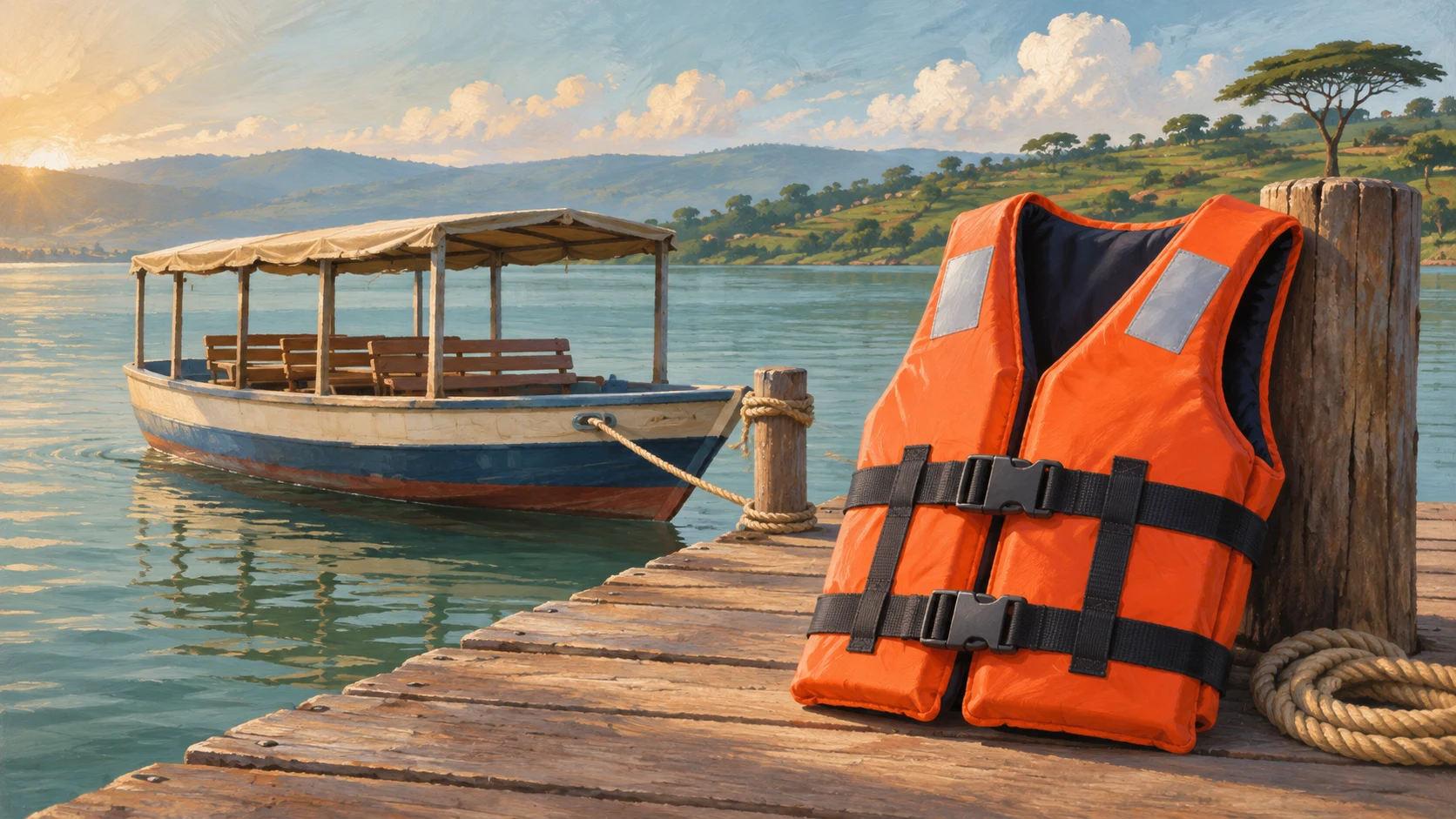
Today, a boat left Kigoma, Tanzania, bound for Kalemie in the Democratic Republic of Congo. It was carrying about 100 people plus cargo when it capsized on Lake Tanganyika near the village of Mapera. At least 41 are dead. 49 were rescued, and the search for the rest continues. U.S. News & World Report
I don’t know their names yet. I may never know them. That is part of the problem.
Two years ago on Lake Kivu, a man named Nzonga lost eight relatives when their boat went down near Goma. A few days later, reporters found him lining up to board another boat across the same lake. He admitted it was dangerous to travel without a life jacket. He also noted that the government doesn’t provide them. Voice of America
He got on the boat anyway. What choice did he have?
The law is already on the books
Nobody can say these governments haven’t acted. On paper, they have.
In April 2019, after a disaster on Lake Kivu, President Félix Tshisekedi declared a national day of mourning and announced he would make flotation devices obligatory for passengers on the lake. Al Jazeera
In Uganda, the Ministry of Works and Transport issued a directive in August 2024 requiring life jackets for all passengers on inland water vessels, grounded in the Inland Water Transport Act 2021 and the Lake Victoria Transport Act 2007. The junior minister warned that vessel owners who fail to carry life-saving appliances would be prosecuted, and that passengers who don’t wear them would also face legal action. allafricaallafrica
Mandatory. Prosecutable. Done.
Then look at who is still dying. In September 2025, two boat accidents in Equateur province, about 150 kilometres apart, killed at least 193 people in two days. Most of the dead on one of them were students. On such journeys, life jackets are rare and boats are usually overloaded. This July, a boat capsized where the Kasai and Sankuru rivers meet, leaving at least 20 dead and more than 100 missing. At least 190 people reported dead after two boat capsizes in DRC Congo - ABC News +3
The law did not float. Not one of them.
Punishment without provision
Here is the number that should end the debate about whether enforcement alone works.
Researchers from Makerere University surveyed 1,343 fishers and transporters at 18 landing sites on Lake Albert. Of those 1,343 boaters, only 10 were actually seen wearing a life jacket as they came ashore. That is 0.7 percent. nih
And 571 of those same boaters, more than four in ten, reported having been arrested at some point for not wearing a life jacket. Their reported wear rate was essentially no different from those never arrested. nih
We arrested nearly half the lake. Wear rates stayed flat. Arrests did not produce safety. Arrests produced arrests.
A jacket or dinner
Now do the arithmetic a fisher does every morning.
Lawrence John Okoth of Design Without Borders has said that many life jackets cost between 80,000 and 200,000 shillings, while most fishers will want to spend about 30,000 or less. allAfrica.com
That gap is not stubbornness. It is survival math. In the Lake Albert study, 270 boaters reported household spending of under 50,000 shillings a week. For one in five fishers, the cheapest jacket on the market costs more than feeding the whole family for a week. nih
So they buy what they can. A Kampala trader told the Daily Monitor that a jacket rated for 45 kilograms sells for 80,000 shillings, one for 70 kilograms for 150,000, and most buyers take the cheaper one. A grown man in a child-weight jacket is wearing a costume, not a lifesaving device. Monitor
Even Uganda’s own former transport minister saw it. General Edward Katumba Wamala urged the government to drop taxes on quality life jackets, arguing that “The issue of life jackets should be considered as medicine.” MonitorMonitor
He’s right. We don’t arrest people for being unable to afford medicine. We don’t tax medicine as a luxury. Why are we doing both with flotation?
Jackets that don’t work
It gets worse. The jackets people can afford often do not float.
When researchers tested 22 new life jackets bought at Lake Albert landing sites, every single one failed the minimum buoyancy requirement. Only 4 percent turned a wearer face-up within five seconds. 45 percent sank within 48 hours of being placed in the water. Taylor & Francis OnlineTaylor & Francis Online
But every one of them had the two mandatory features under Ugandan standards: a whistle and reflective material. ResearchGate
Read that again. We regulated the parts an inspector can see from the dock. We did not regulate the part that keeps a person alive.
Fishers already knew. Researchers had documented that many lakeside fishers avoid wearing jackets because they actively distrust the quality of what’s sold locally. We called it a behaviour problem. It was a product problem. Taylor & Francis Online
The deaths we refuse to count
Here is the most uncomfortable truth in drowning prevention.
Global drowning estimates exclude deaths from water transport and flood disasters, both of which are frequent across Africa and other low- and middle-income countries. nih
The ferry dead are not in the headline number. The students in Equateur are not in the headline number. The 41 on Lake Tanganyika this morning will not be in the headline number.
We have no reliable registry of who drowns while boating. Our registry is the news cycle. Boats in the DRC are routinely overloaded and official manifests don’t list everyone on board, and night travel often leaves many bodies unaccounted for. A person who was never on the manifest cannot be missing from it. Al JazeeraDaily Sabah
Then there are the people fleeing on the open sea. In 2025, at least 2,185 people died or went missing in the Mediterranean, and 1,214 on the West Africa to Canary Islands route. The IOM says the real toll is likely higher, with at least 1,500 more reported missing at sea but unverifiable. Three boats carrying the remains of 42 people were eventually found drifting off Brazil and the Caribbean after trying to reach the Canaries. UN / IOM MIGRANT DEATHS 2025 | UN Audiovisual Library +2
They drowned. We file them under migration. We file the ferry dead under transport. We file them everywhere except where they belong.
If it’s not counted, it’s not funded. If it’s not funded, it’s not if but when.
What provision actually looks like
There is a better model, and some of it is already being built.
In Uganda, the Enhancing Fisherfolk Safety Project, supported by Bloomberg Philanthropies, brings together Design Without Borders Africa, Reach A Hand Uganda, the Global Health Advocacy Incubator and Makerere University School of Public Health. Fishers help design, test and improve locally manufacturable flotation devices and weather information systems. That is the right order. Ask the people on the water first. NilepostNilepost
The evidence also points to what moves the needle. On Lake Albert, boaters who had attended a life jacket training session and those whose boats had space to store jackets reported wearing them more often. Training works. Design works. Handcuffs don’t. nih
So here is what I am asking of every government that has passed a life jacket mandate:
Provide before you punish. Free or subsidized jackets at landing sites and ports. Lending banks at every major departure point. If the state requires it, the state must make it reachable.
Take the tax off. Treat certified flotation like the medicine it is.
Regulate buoyancy, not decoration. Test jackets at the point of sale. Pull the ones that sink off the shelf.
Enforce at the dock, not in the water. On Lake Kivu, boats aren’t supposed to leave port without the lake commissioner’s authorization. That signature is the enforcement point. No jackets, no departure. Hold the operator and the port accountable, not the passenger who had no alternative. Voice of America
Count every drowning. Water transport and migration deaths belong in national and global drowning data. Manifests must be real.
A mandate without a jacket is not a safety policy. It is a way for a government to say it acted, while the families on the shore wait for boats that will never come in.
Nzonga got back on the boat because he had no other way home. The least we owe him is something that floats.
Nathalie
Sources and further reading
- Associated Press — Lake Tanganyika boat capsizing, 24 September 2026
- voanews.com — 7818547.html
- aljazeera.com — dr congo observes day of mourning for boat accident victims
- allafrica.com — 202408020464.html
- abc.net.au — 105769772
- pmc.ncbi.nlm.nih.gov — PMC9726957
- allafrica.com — 202507230652.html
- monitor.co.ug — why a life jacket may not save you 1796146
- monitor.co.ug — gen katumba why should life jackets be highly taxed 4597874
- tandfonline.com — 10803548.2023.2298147
- researchgate.net — 377145805 Lifejackets or just jackets Seaworthiness of lifejackets sold at landing sites on Lake Albert Uganda
- aljazeera.com — dr congo dozens drown many missing as boat sinks in lake
- dailysabah.com — at least 100 dead after boat capsizes in congo
- media.un.org — d3539494
- nilepost.co.ug — design without borders africa marks world drowning prevention day with kigungu fishing community
Originally published by Swim Global Project on September 25, 2026.
Original publication on Substack ↗