
When I started Swim Global Project, I imagined a network of people around the world who understood something simple but urgent: water does not discriminate, and neither should safety. Drowning prevention is not a distant, abstract cause. It happens in villages without access to swim lessons, in refugee camps far from any pool, and yes, in American beach towns just minutes from the ocean.
That is why Anna Newman’s story matters so much to me. Anna is one of our Ambassadors, and she embodies exactly what this project is about. She is not writing from the sidelines. She is a lifeguard, an EMT, and a former competitive swimmer who chose to spend her summer teaching children who had never put their faces in water how to feel safe in it. Her work with the Wrightsville Beach Ocean Rescue Community Engagement Team reminds us that the same inequities we talk about on a global scale exist quietly in our own backyards.
This is the heart of Swim Global Project. We are not just documenting drowning prevention efforts around the world. We are building a community of people, like Anna, who refuse to accept that where you are born or which neighborhood you grow up in should determine whether you know how to survive in water. I am proud to share her story, and even prouder of the work behind it.
Nathalie Martin
Founder, Swim Global Project
Here is Anna, in her own words.
My name is Anna Newman. I am a former Division I collegiate swimmer, a fourth-year ocean rescue lifeguard for Wrightsville Beach Ocean Rescue in North Carolina, a certified EMT-Basic, and a proud Swim Global Project Ambassador. I care deeply about water safety education, public health initiatives around drowning prevention, and equitable access to safety resources for those who need it most. I want to share some of the community engagement work happening within and around the Wrightsville Beach Ocean Rescue community.
Wilmington, and Wrightsville Beach in particular, is a favorite coastal summer destination for families across the state and country. The area draws nearly 2 million visitors annually, and interest in North Carolina’s coastline has only grown in recent years. “This has been a busy start to the summer. Probably one of the busiest starts,” said Wrightsville Beach Ocean Rescue Director Sam Proffitt at the start of the 2026 season. For many of these visitors, a trip to Wilmington means their first encounter with open water, sometimes even their first glimpse of the ocean.
The stakes behind that first encounter are real. Rip currents have caused an average of eight drowning deaths a year across North and South Carolina since 2000, making them the leading weather-related killer along the coastal Carolinas.¹ Half of those who died were visiting from out of state, and only about one in five lived in the coastal Carolinas themselves, a reminder that education has to reach far beyond the beach towns.¹ Where lifeguards are present, the risk drops sharply. The odds of drowning at a beach protected by a USLA-affiliated lifeguard service are about one in 18 million.²
Wrightsville Beach Ocean Rescue (WBOR) is a certified advanced lifesaving public safety agency dedicated to the safety of beach patrons in and around the water. Prevention is central to that mission. Our lifeguards are trained to educate beach patrons on rip currents, lightning, and the other hazards that come with time spent on the water and the beach strand.
But public safety signage only reaches so far. There is an urgent need to bring water safety education into underserved communities in downtown Wilmington, many of which sit just fifteen minutes from the Atlantic. A generational fear of water, compounded by limited access to public pools and swim lessons, means many residents in these communities never get the chance to learn to swim at all. The data bears this out nationally. Only about 46 percent of Black children and 47 percent of Latine children have had swimming lessons, compared to 72 percent of white children, and nearly a quarter of Black parents and roughly a third of Latine parents report never having learned to swim themselves.³·⁴ That generational gap shows up in the drowning data too: Black children ages 10 to 14 drown in swimming pools at rates 7.6 times higher than white children.³ This is not a minor inconvenience. It is a significant and urgent drowning risk hiding in plain sight, one that follows children from the pool to the ocean.
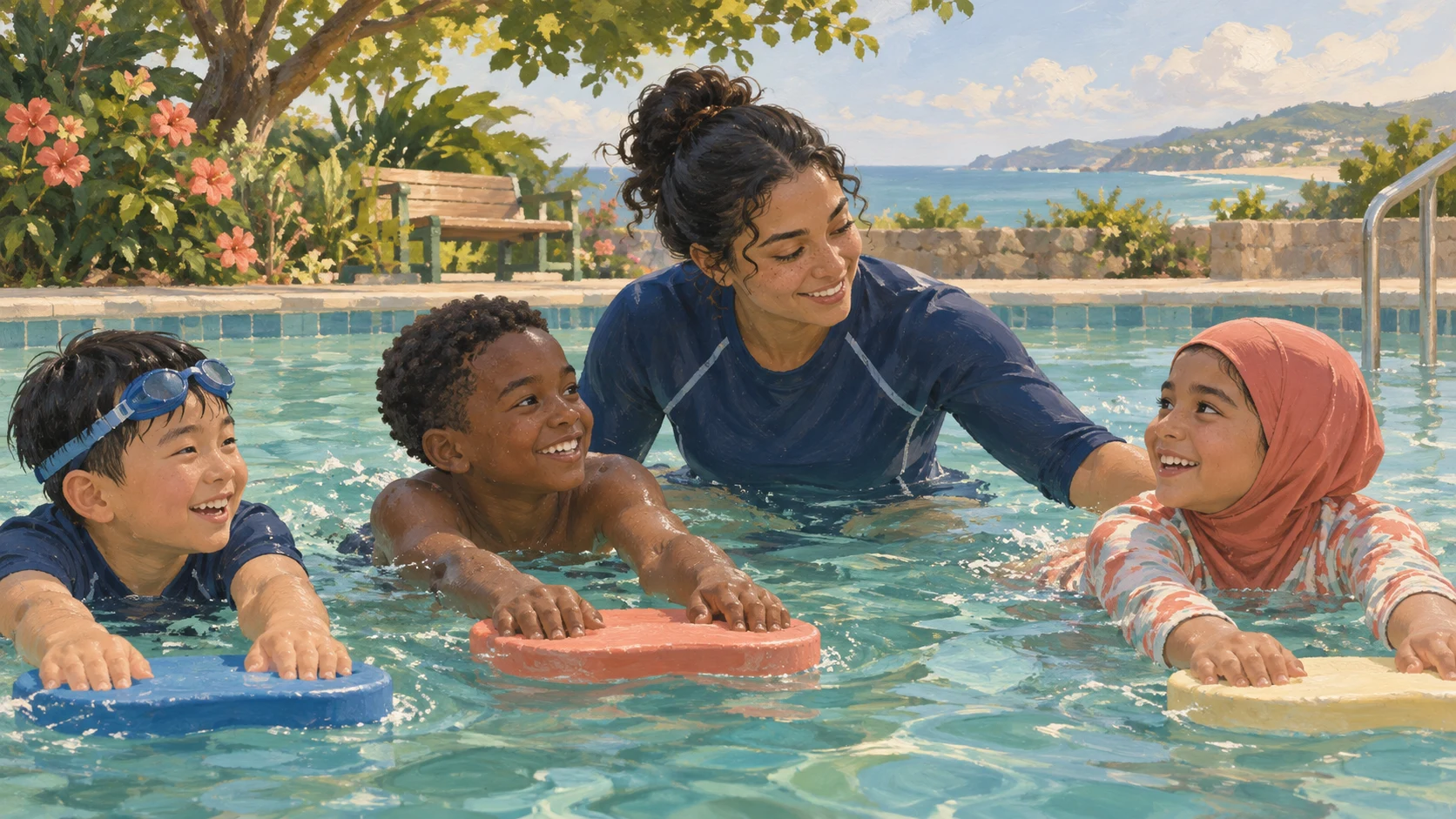
WBOR’s Community Engagement Team has worked to close that gap, extending free swim lessons, water safety education, and open water opportunities to underserved youth in downtown Wilmington. This work began in 2023 under the leadership of WBOR lifeguard and fellow Swim Global Project Ambassador Craig Dodson, who launched local school visits and early community engagement efforts. In the summer of 2026, I joined eight other committed WBOR lifeguards in earning our American Red Cross Water Safety Instructor certifications, and together we began teaching free swim lessons to underserved youth at Northside Elite Aquatics in downtown Wilmington.
Despite living so close to the ocean, many of these children had never taken a swim lesson. Some had never even put their faces in the water. Our goal is simple: build safety knowledge, comfort, and confidence in and around water. As an ocean rescue agency, this work has been some of the most rewarding we do, and we are committed to growing our relationships with local pools, especially those serving Wilmington’s underserved communities.
Sources
1. National Weather Service, Wilmington, NC — Rip Current Statistics: weather.gov/ilm/ripcurrents
2. Spectrum News NC1, “Breaking down beach dangers: North Carolina’s alarming rip current crisis,” April 28, 2025: spectrumlocalnews.com/nc/charlotte/weather/2025/04/28/rip-current-fatalities-in-north-carolina
3. Centers for Disease Control and Prevention, “Health Disparities in Drowning”: cdc.gov/drowning/health-equity/index.html
4. Northwestern University / Ann & Robert H. Lurie Children’s Hospital of Chicago, “Racial, ethnic disparities in swimming skills found across generations,” December 2022: news.northwestern.edu/stories/2022/12/racial-ethnic-disparities-in-swimming-skills-found-across-generations
Originally published by Swim Global Project on July 19, 2026.
Original publication on Substack ↗