
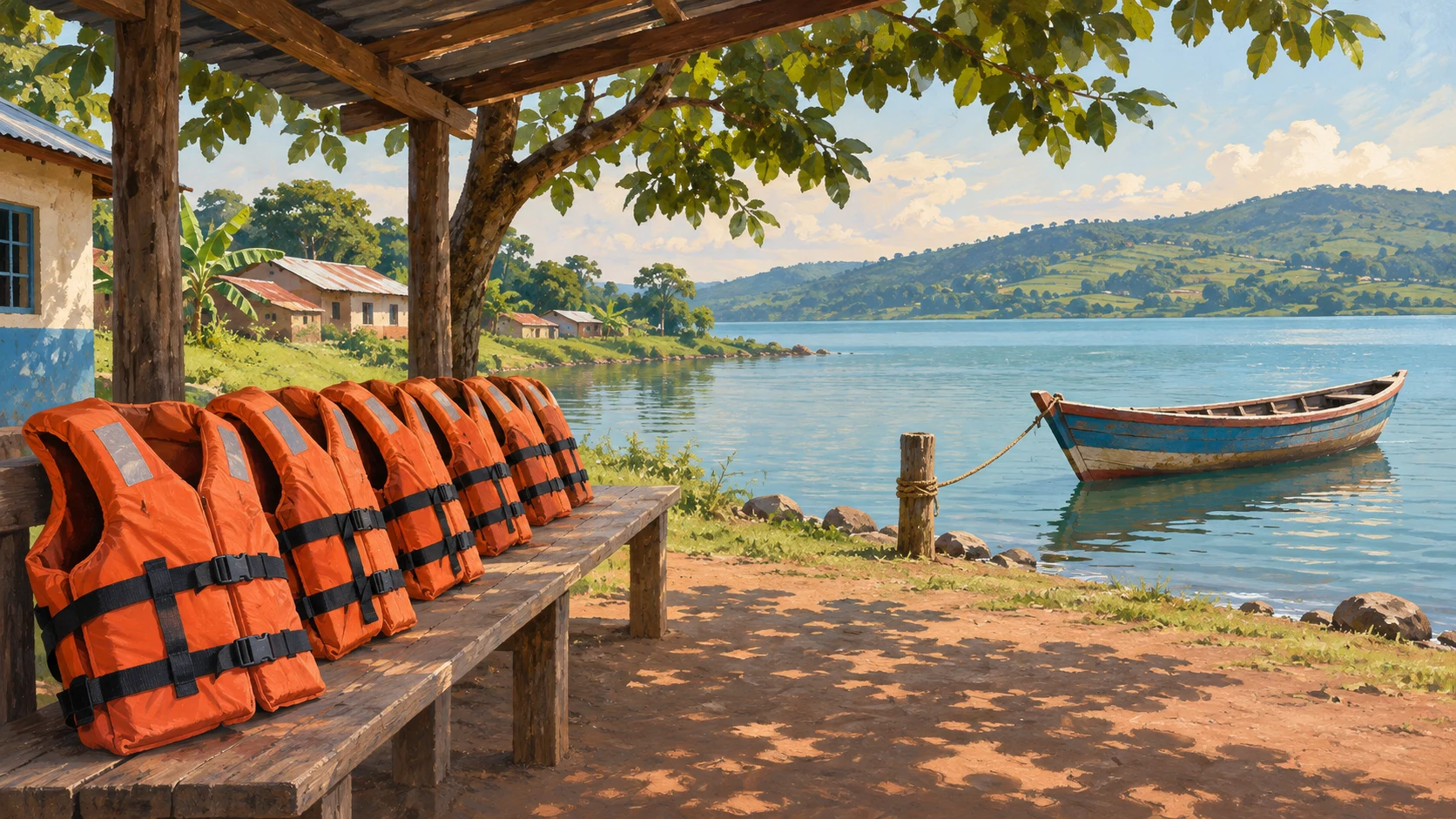
Drowning prevention in Uganda is not a story of a single organization, a single campaign, or a single famous name. It is a story of persistence, of what happens when researchers, advocates, government leaders, educators, lifesaving organizations, and community champions stay committed year after year, even when progress feels slow.
There is a number that should stop you mid-scroll: roughly 3,000 Ugandans drown every year. That is about eight people a day. A fisherman who never comes home. A child fetching water from a pond. A passenger on an overloaded boat crossing Lake Victoria. According to estimates from the Makerere University School of Public Health, drowning in Uganda now rivals road traffic deaths as a cause of preventable loss of life.
And here is the harder truth: for decades, almost nobody was counting.
The problem you can’t see is the problem you can’t solve
When researchers at the Makerere University School of Public Health set out to understand drowning in Uganda, they discovered that official records told only a fraction of the story. Their landmark study, Understanding and Preventing Drowning in Uganda, reviewed administrative records across 60 districts between 2016 and mid-2018 and found 1,435 fatal and non-fatal drowning cases. But when the team went deeper, sending community health workers into just 14 of those districts to interview witnesses, survivors, and families, they uncovered more than 2,000 additional cases. The community-based approach revealed over three times the number of drowning deaths found in official records.
In Uganda’s lakeside fishing communities, the research is even more sobering. A study led by Dr. Olive Kobusingye and colleagues around Lake Victoria found a drowning fatality rate of 502 deaths per 100,000 people in these communities, among the highest documented anywhere in the world. Nearly three quarters of those surveyed did not know how to call for rescue. Fewer than half could swim.
This is what a silent epidemic looks like. The World Health Organization’s first-ever Global Status Report on Drowning Prevention, released in December 2024, estimated 300,000 drowning deaths globally in 2021, with 92 percent of them in low- and middle-income countries. And while global drowning death rates fell by 38 percent between 2000 and 2021, in Africa they fell by just 3 percent.
Numbers like these can feel paralyzing. They shouldn’t. Because the rest of Uganda’s story is about what happens when people refuse to look away.
Progress that is measured in years, not headlines
Here is the thought-provoking part, the part that doesn’t fit neatly into a fundraising appeal or a viral post: drowning prevention in Uganda has taken years of unglamorous, coordinated effort, and it is working precisely because of that.
Consider the timeline. Researchers spent years building the evidence base, district by district, interview by interview. Makerere’s Trauma, Injuries and Disability Unit then translated that research into a national drowning prevention strategy. Parliament established a Forum on Roads and Water Safety. In 2023, the government launched the National Drowning Prevention and Water Safety Strategic Plan, a multi-ministry commitment backed by Bloomberg Philanthropies, with a clear target: reduce drowning deaths in Uganda by 25 percent by 2028. The Ministry of Works and Transport was designated the lead agency, coordinating with the Ministries of Health, Water and Environment, and Education and Sports.
On the ground, organizations like Reach a Hand Uganda are implementing the strategy in the highest-risk lakeside districts of Mayuge, Masaka, and Rakai through the Omanyi Okuwuga (”Do You Know How to Swim?”) campaign, building community swimming pools, training instructors, and teaching survival swimming to hundreds of school children and adults. The Lifesaving Association Uganda (LISA Uganda) provides the instructional backbone, with its Trainers of Trainers ensuring quality and consistency at every site. Design Without Borders and the Makerere School of Public Health keep the work grounded in evidence. And in March 2026, the Ministry of Water and Environment launched Uganda’s first National Water Safety Swimming Gala, a public signal that swimming is being reclassified from recreational luxury to critical survival skill.
No single one of these milestones changed everything. Together, sustained over a decade, they are changing everything.
That is the central truth this work keeps teaching: coordinated efforts take years, but consistent people make them possible.
The consistent people: meet George Mukasa
Every long effort has people who simply never stop showing up. In Uganda’s water safety movement, George William Mukasa is one of them.
In a recent live conversation with the Swim Global Project, George traced his commitment back roughly four decades, to his primary school days, when the school’s water pump would break down and children would go to a nearby river to swim and fetch water. Not all of them came back.
“I saw so many people in my village drowning, and no one knew what to do. No one could do CPR. Every time we lost a child, I said: this must stop. That was my calling.”
He was in primary four when he first told his teachers that the drowning had to end. By primary seven, he had learned to swim and was teaching his classmates how to swim and survive. He went on to become a champion competitive swimmer, and then made a deliberate choice that defines his life’s work: “I’ve won so many medals. I’ve been a very good champion in the pool,” he says, so he crossed to the other side of aquatics, to the people the pool never reaches.
In 2011, he was part of the formation of the Uganda Lifesaving Federation (ULF), the country’s first national body dedicated to stopping drowning. The organization was later revamped, and during the COVID-19 pandemic George founded the Lifesaving Association Uganda (LISA Uganda), refusing to let one emergency eclipse another:
“Just as we learned with COVID, persistent threats demand persistent action. Drowning is no different.”
Today George is the President of LISA Uganda, now a full member of the International Lifesaving Federation, a board member of ILS Africa Region, and a Swim Global Project Ambassador.
The capacity building under his leadership is where persistence becomes measurable. LISA Uganda has trained more than 500 lifeguards and, across 2024 and 2025, produced Uganda’s first ever 120 STA UK and IFSTA certified swimming teachers. The courses were deliberately held in the country’s most drowning-prone areas: at Lake Bunyonyi in Kabale, the second deepest lake in Africa and the deepest in Uganda, and in the Kalangala Islands, where an estimated 70 percent of the nation’s drowning cases are reported, driven by daily fishing activities. When LISA Uganda was not chosen as the lead organization for the Bloomberg-supported program in the lakeside districts, George partnered anyway, training community responders and swimming teachers alongside Reach a Hand Uganda. “We were open-minded, like we’ve been before, to work along,” he says. “That’s how we are resilient: doing things even by consulting, getting people to show us the way.”
That resilience is now being matched with investment in leadership. George was recently selected for the second cohort of a Bloomberg-supported injury prevention leadership program affiliated with Johns Hopkins, running in Kampala, one of ten Ugandan representatives among more than forty delegates from government, local communities, and civil society. His vision for the year ahead is unmistakably about the long game:
“This course is going to help us become leaders from different sectors, to bring all our energy on one table, and to do more of prevention than firefighting. It’s about leadership, putting structures, policies, advocacy, and then we’ll be able to get results.”
He is clear-eyed about the funding reality facing low- and middle-income countries, where the overwhelming majority of the world’s drowning deaths occur: waiting for outside aid means losing time. “What can we do in our context that will not cost us a lot, but will bring all our energy?” he asks. And when told to keep going and never give up, his answer comes without hesitation:
“No. We can’t give up.”
What makes George’s work remarkable is not any single event. It is the consistency. Forty years from a primary school promise to a national organization. The years of training instructors. The willingness to do the slow institutional work of curriculum, certification, and partnerships that never trends but always matters.
Movements are not built on single moments of recognition. They are built by people like George, the ones still there in year five, year ten, year forty.
What persistence actually looks like
If you have followed global development work for any length of time, you know the pattern: a crisis makes headlines, funding surges, pilot programs launch, attention fades, programs collapse. Drowning prevention in Uganda is quietly modeling a different pattern, one the WHO report explicitly calls for: multisectoral collaboration, sustained over time, anchored in national strategy and local ownership.
It looks like researchers who kept publishing when nobody was reading. Government engineers and commissioners who kept drafting regulations for the estimated 70,000 vessels on Uganda’s lakes and rivers. Community health workers who knocked on doors to count deaths no registry had recorded. Swim instructors who showed up at the pool every morning. An ambassador who treats every landing site, every school visit, and every training as another brick in a wall that takes a generation to build.
Progress feels slow because it is slow. That is not a flaw in the model. That is the model.
And it is why the people in this movement deserve more than admiration. They deserve company.
Be part of what comes next
This is where you come in. Building on the kind of persistence Uganda models, the Swim Global Project is building WaterSafe Communities®, a framework for expanding access to swimming and lifesaving education in the places that need it most. And the work grows through people who are willing to stay, which is exactly how George started.
Beginning in August, the Swim Global Project will be recruiting its third cohort of ambassadors: professionals, volunteers, educators, and advocates ready to carry water safety into their own communities around the world. Whether you represent an organization, a community initiative, or a research institution, teach where you live, or simply care about ending preventable drowning, there is a place for you in this.
Because the lesson from Uganda is not just that drowning is preventable. It is that prevention belongs to everyone willing to stay. Every connection and every action brings us one step closer to a world where no life is lost to preventable drowning.
Anyone can drown. No one should. And no one has to do this alone.
Sources: World Health Organization, Global Status Report on Drowning Prevention (2024); Makerere University School of Public Health, “Understanding and Preventing Drowning in Uganda” (2020); Kobusingye et al., “Drowning among the lakeside fishing communities in Uganda,” International Journal of Injury Control and Safety Promotion (2017); Uganda Ministry of Works and Transport / Ministry of Water and Environment; Daily Monitor; The Independent (Uganda); PML Daily; Global Health NOW.
Learn more: Swim Global Project · Reach a Hand Uganda · Lifesaving Association Uganda · George William Mukasa on LinkedIn
Sources and further reading
Originally published by Swim Global Project on June 22, 2026.
Original publication on Substack ↗