
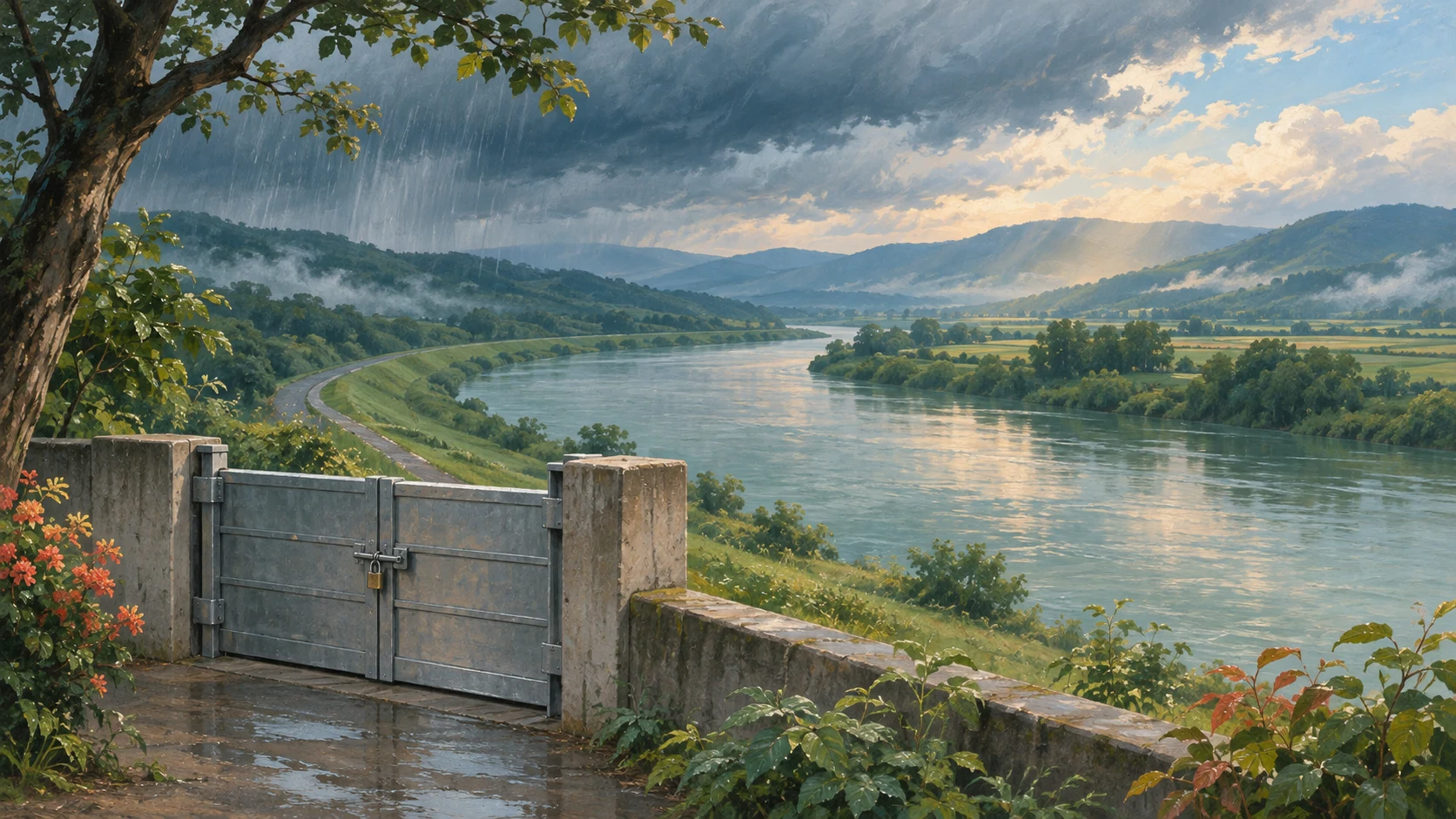
There is a word the mothers use now. Before. As in, before the water came, before the phone rang, before they knew what a mesoscale convective vortex was or why it should have mattered to anyone in charge. On this month’s Dateline, one of them, Patricia Bellows, told Lester Holt that the person she was before her daughter died is simply gone. Eight of these mothers sat together on that broadcast because they have become one another’s only real company. Few other people can follow them into the after.
I have spent my career in drowning prevention, and I have learned to be careful with numbers, because numbers are where grief goes to disappear. So let me start where the story actually lives, which is not in a spreadsheet. On July 4, 2025, twenty-five girls and two counselors died at a summer camp on the Guadalupe River. Dick Eastland, the camp’s director, died trying to carry children out of the dark. Across the Texas Hill Country that morning, more than 130 people were lost. Those are not casualties. They are a Sunday school class, a cabin’s worth of best friends, a town’s worth of neighbors. Camp Mystic was not a death toll. It was a community, and the flood took the community, not just the count.
The river rose about twenty-six feet in forty-five minutes. I want you to sit with that the way I have had to. Not a slow, creeping thing you can walk away from, but a wall of water arriving faster than a sleeping child can wake. Six inches of moving water can take an adult off their feet. Two feet can carry away a car. The Guadalupe brought thirty. This is what water does, and it is why drowning, not wind, not lightning, not the storm’s spectacle, is the leading cause of death when a flood comes. Inland flooding is the deadliest weather hazard in this country, year after year, and most of us in water safety are still talking about backyard pools and open water while the single largest killer sits outside the tent.
That is the argument I most want to make, so I will make it plainly. Flooding is a drowning issue. It is our issue. When a river rises and children drown in their bunks, that is not a meteorology story that happens to involve water. It is the same fight I have given my life to, wearing a different face. If the drowning prevention field does not claim flood risk as its own, we are conceding the deadliest ground we have.
And here is what should stop us cold. Worldwide, the World Health Organization estimates that drowning causes about three out of every four deaths in a flood disaster. Yet flood victims are not even counted in the roughly 300,000 drowning deaths the world records each year, because the official tally deliberately leaves out deaths from flood disasters and water transport. In some high-income countries, that exclusion hides as much as half of the true drowning toll. Depending on which global dataset you trust, floods kill somewhere between about 6,600 and 17,000 people a year, which means thousands of flood drownings, every single year, that never reach the number we quote from podiums on World Drowning Prevention Day. We are not just failing to prevent these deaths. We are failing to count them.
Now to the part that keeps me up at night, because it is the part that turns a tragedy into an indictment.
We knew.
We knew the Hill Country is called Flash Flood Alley, and we knew why. Kerr County officials had wanted a flood warning system for the better part of a decade. The price was about a million dollars. The state turned the county down more than once. Federal preparedness money was available and, in 2021, the county steered a ten-million-dollar relief grant toward other things, in part because a slice of local voters did not want to take federal money at all. The National Weather Service did its job. It issued a flash flood warning at 1:14 in the morning and escalated it to an emergency. But the warning reached phones while the county slept, and many of the campers had handed their phones in at the start of the session. The county had a wider-reaching alert system it could have triggered to push a message to every phone in the flood’s path. It did not use it in those critical hours.
And the camp. Investigators found what the families already knew in their bones. Cabins built inside a federal floodway. No written evacuation plan. Counselors who had never been trained for the one emergency the geography guaranteed. A policy that told girls to stay put and wait. And here is the detail that turns my stomach: over the years, as the camp appealed its flood designation, FEMA had quietly redrawn the maps and lifted some thirty of Mystic’s buildings out of the official hazard area, even as the camp kept expanding along the bank. The risk did not shrink. Only the paperwork did. One father, Michael McCown, who lost his eight-year-old daughter Linnie, put it to lawmakers as simply as it can be put: no one had to die that day.
The state was not a bystander to this. Its own health agency inspected Camp Mystic and renewed the camp’s license two days before the flood, even though Texas law required a written, posted evacuation plan that Mystic did not have. Nine families are now suing the state over that license. The camp itself had hoped to reopen this summer for its hundredth anniversary. After the families’ outcry it withdrew its application and stayed closed, and this June it filed for Chapter 11 bankruptcy, a filing that now stands between those same families and the answers a trial might have pried loose.
That is what makes this different from a hurricane no one saw coming. Nobody has to invent the solutions. We have them. Gauges in the river. Sirens on the bank. Weather radios in every cabin. Evacuation plans that are written down, drilled, and rehearsed before the first camper arrives. A rule that a flood warning means move to high ground now, not a debate to be had at two in the morning by exhausted teenagers. Do not build where the water is known to go. None of this is new. None of it is exotic. All of it existed on July 3, and almost none of it was in place on July 4.
Texas did respond, and I will give the state its due. In the months after, lawmakers passed the Heaven’s 27 Camp Safety Act, named for the twenty-seven campers and counselors who died at Mystic, requiring multi-hazard plans, annual staff training, camper drills, weather radios, and mandatory evacuation to higher ground when a flash flood warning is issued. They funded a siren grant program and better forecasting, spending more than a quarter of a billion dollars. Good. Necessary. And it should shame us that it took twenty-seven children to buy what a million dollars and a little political courage could have bought a decade earlier. Reform written in the past tense is just a receipt for what we already knew.
Here is the sentence I need every parent, camp director, and county commissioner to carry: it is not a question of if, but when. The rain is coming back. The science on extreme precipitation is not ambiguous, and the map of vulnerable communities is long. The next Guadalupe already exists somewhere, with its own decade of denied applications and its own cabins a little too close to the bank. The only open question is whether we treat Camp Mystic as a warning we heed or a story we mourn and forget.
I keep returning to these mothers, sitting together because no one else can reach them. We owe them more than sympathy. We owe them the boring, unglamorous, entirely achievable work of making sure the after they are living in is the last one of its kind. That is how you honor the people. Not with a moment of silence, but with a siren that actually sounds, a plan that actually runs, and a field that finally says out loud that when the water rises, this is our fight too.
It was always about the people. It still is.
References
Camp Mystic and the July 2025 Texas Hill Country floods
-
Poynter, “After the flood, remembering a tragedy from one year ago” (NBC Dateline “After the Flood”; Patricia Bellows and the eight mothers). https://www.poynter.org/commentary/2026/camp-mystic-flood-one-year-anniversary-nbc-dateline/
-
NBC 5 Dallas-Fort Worth, “Central Texas flooding is revisited on Dateline Friday night.” https://www.nbcdfw.com/news/local/texas-news/dateline-looks-back-on-deadly-central-texas-flooding/4041566/
-
CNN, “Girls as young as 7 were startled awake by flooding that devastated their beloved Camp Mystic.” https://www.cnn.com/2025/07/13/us/camp-mystic-flooding-texas
-
CBS News Texas, “Camp Mystic files for bankruptcy nearly a year after deadly Texas floods” (state license two days before the flood; nine families suing the state). https://www.cbsnews.com/texas/news/camp-mystic-files-for-bankruptcy-nearly-a-year-after-deadly-texas-floods-that-killed-campers-counselors/
-
KUT, “Camp Mystic files for bankruptcy relief a year after flood.” https://www.kut.org/business/2026-06-24/camp-mystic-bankrupt-texas-flood-deaths
-
Texas Tribune, “Did fiscal conservatism block plans for a new flood warning system in Kerr County?” https://www.texastribune.org/2025/07/10/texas-kerr-county-commissioners-flooding-warning/
-
NPR, “Kerr County struggled to fund a flood warning system. It’s all too common.” https://www.npr.org/2025/07/10/nx-s1-5461091/texas-flooding-warning-system-fema
-
NBC 5 Investigates, “FEMA records show Kerr County officials didn’t send EAS warnings to phones as flooding began July 4.” https://www.nbcdfw.com/investigations/fema-records-kerr-county-didnt-send-eas-flood-warnings-phones/3882922/
-
Wikipedia, “July 2025 Central Texas floods” (Guadalupe River rise; FEMA floodway designation and map revisions). https://en.wikipedia.org/wiki/July_2025_Central_Texas_floods
-
Texas Senate News, coverage of the Heaven’s 27 Camp Safety Act (Senate Bill 1) and family testimony, including Michael McCown. https://senate.texas.gov/news.php?id=20250821a
-
KUT, “Sirens, summer camps and weather alerts: Here’s what is changing in Texas after the special session.” https://www.kut.org/politics/2025-09-04/texas-flood-special-session-youth-camp-mystic
-
Texas Water Development Board, “Senate Bill 3 Implementation” (outdoor warning siren grant program). https://www.twdb.texas.gov/about/sb3/index.asp
Flooding, drowning, and the global data
-
World Health Organization, “Drowning” fact sheet: roughly 300,000 annual drowning deaths worldwide; drowning accounts for 75 percent of deaths in flood disasters. https://www.who.int/news-room/fact-sheets/detail/drowning
-
United Nations, “World Drowning Prevention Day”: note that global estimates significantly underestimate the true burden of drowning. https://www.un.org/en/observances/drowning-prevention-day
-
Bulletin of the World Health Organization, “Global, regional and national trends and impacts of natural floods, 1990 to 2022”: 218,353 recorded flood deaths from 1990 to 2022; an earlier study estimated more than 500,000 flood deaths from 1980 to 2009. https://pmc.ncbi.nlm.nih.gov/articles/PMC11132161/
-
Johns Hopkins Bloomberg School of Public Health, “The Dangers of Floodwater”: drowning is the leading cause of death during flash and coastal floods; six inches of moving water can knock over an adult and one to two feet can carry away a car. https://publichealth.jhu.edu/2024/the-dangers-of-floodwater
Originally published by Swim Global Project on July 2, 2026.
Original publication on Substack ↗